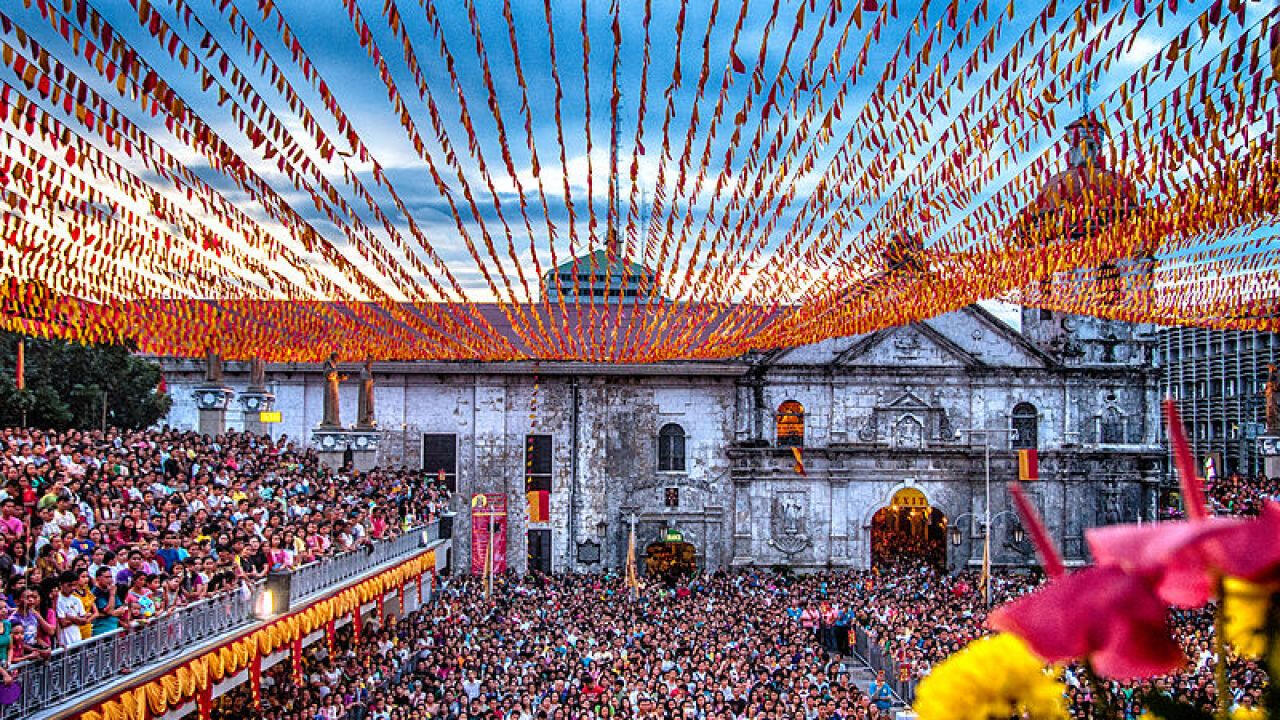
SINULOG FESTIVAL
(honoring of sto. niño)
Ang Sinulog festival ay ang pinaka kilala na pagdiriwang sa Cebu. Mas kilala rin ang Sinulog festival sa mga street party nito bago ang araw ng pagdiriwang at sa araw ng pag diriwang ng mga tao. Umabot sa isang milyon hanggang dalawang milyon ang mga bisita at travelers na nang galing sa ibang bansa na naka punta sa Cebu para sa pagdiriwang na ito.
HISTORY
(History of Sinulog Festival)
Sinulog is held in celebration of one of the country’s most famous historic relics: the Santo Niño de Cebu. This was the statue of the baby Jesus that was handed to the Rajah Humabon of Cebu by the Portuguese explorer Ferdinand Magellan in 1521.
This was one of the most important events in the religious history of the Philippines as it paved the way to the birth of Christianity in the country.
Santo Nino de Cebu or Statue of the baby JesusAt the moment of receiving the holy image, it was said that Queen Juana, the main consort of Rajah Humabon, danced with joy holding this image of the child Jesus.
The other natives followed her example, and this event was regarded as the first Sinulog dance. The same event was used as the basis for most Sinulog dances.
Explore more of Cebu City and the province. Read our article on the Best Tourist Spots in Cebu
The Sinulog dance steps are also believed to originate from Baladhay, Rajah Humabon's adviser. When Baladhay got sick, Humabon ordered his tribe to bring Baladhay into a room where the Santo Niño was enthroned.
After a few days, Baladhay was heard shouting and was found dancing by the native tribe. Baladhay was asked as to why was he was shouting and dancing. He pointed at the image of the holy Jesus and explained that baby Jesus was tickling him.
In turn, Baladhay danced with the little child and explained that he was dancing the movements of the river. To this day, the two-steps forward, the one-step backward movement is still used by Santo Niño devotees who believe that it was the Santo Niño's choice to have Baladhay dance.
Pre-Spanish Period
The ritual dance of the Sinulog dates back to pre-colonial Cebu natives, who danced the two step forward, one step backward movement in honor of their wooden idols and anitos.
April 7, 1521
Historical accounts say that Portuguese explorer headed by Ferdinand Magellan came to Cebu on this date to plant the cross on its shore and claim the country for the King of Spain.
April 1521
Magellan introduced Christianity among the natives. He gave the Santo Niño as a baptismal gift to Hara Amihan, wife of Raja Humabon, who was later named Queen Juana. The rulers and their 800 subjects were baptized around this time.
April 27, 1521
Magellan died in an encounter with the reigning ruler of Mactan, Rajah Lapu-Lapu. What remained of Magellan's men were able to return to Spain to report the incident.
1521 to 1565
Cebu natives continue to dance the Sinulog. This time, they no longer danced to their wooden idols and anitos but as a sign of reverence to the Santo Niño.
April 28, 1565
Miguel Lopez de Legaspi arrives in Cebu. His ships bombarded the village and in one of the burning huts, one of his soldiers named Juan Camus found inside a wooden box the image of the Santo Niño lying side by side with native idols.
16th century onwards
The devotion to the Santo Niño grew and people have venerated the wooden statue by dancing the Sinulog steps. The annual celebration of the Santo Niño has become the Fiesta Señor, which falls on the third Sunday of January. Faithful who joined the Sinulog try to fulfill a panaad or oath/obligation to the Santo Niño. The religious event has since attracted an increasing number of tourists.
1980
David S. Odilao Jr., then regional director of the Ministry of Sports and Youth Development, organized the first-ever Sinulog parade. Odilao invited physical education teachers for a meeting to discuss the organization of a street dance parade.
1981
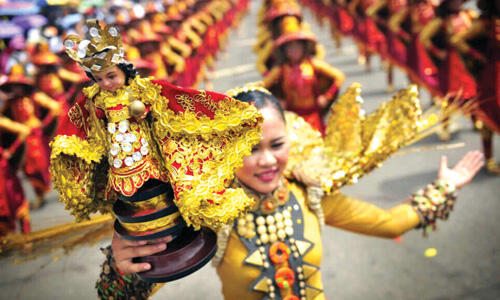
Sinulog '81 was organized. Practically all sectors in the Cebuano community got involved. Organizers depicted in the parade the history of the Sinulog, distinguishing itself from the Ati-atihan Festival in Aklan, which is also a festival in honor of the Santo Niño. Seven floats were created to depict seven different periods of history. Dancers wore costumes during the periods while dancing to the same beat.
1982 to 2020
The festival has grown ever since its conception. New contest categories were introduced such as the search for the annual Festival Queen, puppeteering, photo contests, and film festivals, among others. The number of spectators has also risen annually, seeing more tourists coming from different parts of the Philippines and the world. It also helped boost Cebu's tourism and its identity.
January 7, 2021
The Cebu City Government and officials of Sinulog Foundation Inc. decided to cancel the Sinulog performances at the South Road Properties (SRP), among other Sinulog activities, due to the coronavirus pandemic. This, after the Philippine National Police and other government agencies cautioned against the staging of the festival.